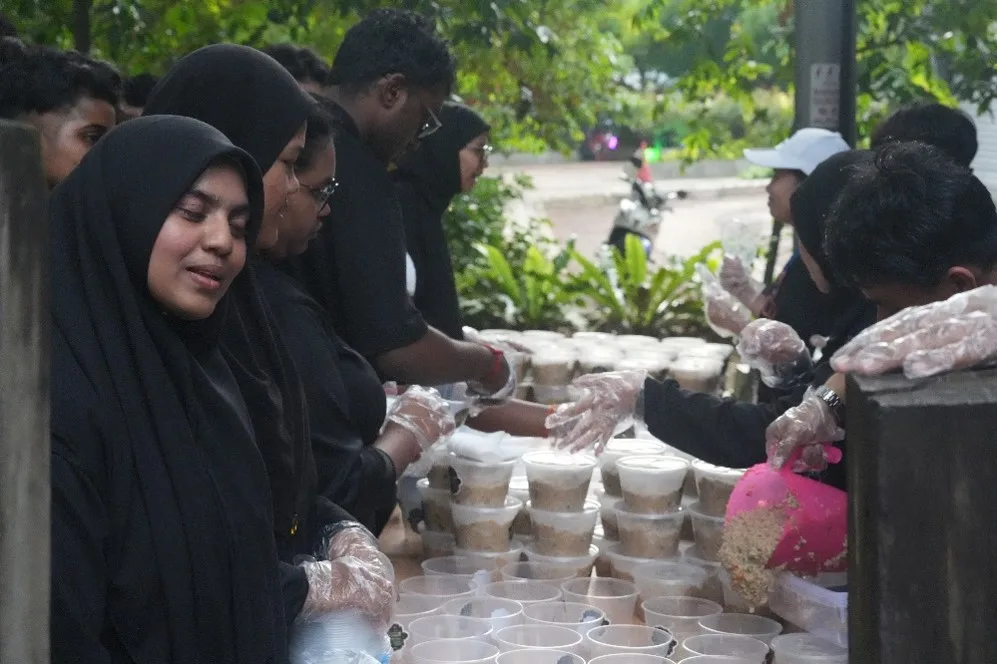
Program Bubur Lambuk Ramadan 2025 Goon International College : A Corporate Social Responsibility Initiative for Community Engagement and Student Development
Bubur Lambuk Ramadan Programme 2025 was carried out by KOR SISPA
Kolej Antarabangsa Goon in conjunction with Angkatan Pertahanan Awam Malaysia
(APM) Wilayah Persekutuan Kuala Lumpur on 21 March 2025. This programme
was carried out with the objective of nurturing qualities of volunteerism, teamwork, and
social responsibility among the students during the holy month of Ramadan. Not only
did the programme carry out the aim of being charitable, but it was also used for the
purpose of learning through experience whereby important soft skills could be
developed among the students.
Ramadan is known as a time when Muslims can think about, show their
compassion and also be generous. It inspires people to engage in acts of charity and
to build up connections among themselves through sharing and sympathy. In line with
the principles mentioned above, the Program Bubur Lambuk Ramadan 2025 was
developed in order to represent the spirit of unity and kindness by involving students,
lecturers, employees and also APM members in a community service program.
Preparing and distributing bubur lambuk, which is a traditional porridge of Malaysia
that is related to Ramadan, became the main point of the program.
In total, there were 432 people who took part in the program, and this included
students, lecturers, administrative officials and APM officers. The high participation
rate showed that the program was greatly supported and proved the success of the
college in organizing their members towards one goal. The program was structured to
achieve full participation by all the participants through different stages which involved
preparation of ingredients, cooking, packing and distribution. Different roles were
allocated to each of the participants to facilitate a smooth process during the
implementation of the program.
2
The other main strength of the program was the strong teamwork that existed
between KOR SISPA and APM staff. The participation of APM staff provided
professionalism in terms of how the activities of such a large scale in the community
should be managed. At the same time, the professionalism guaranteed that all safety
measures and procedures would be observed during the entire process. As a result of
their guidance, students had the opportunity to learn the proper methods of
coordination, handling crises, and leadership in action.
Students were involved in various activities within the project that required
cooperation, communication, and proper time management. In the preparation stage,
students worked as a group to wash the ingredients, measure them, and prepare the
cooking utensils. While cooking, teamwork became indispensable for cooking a
sufficient amount of bubur lambuk, at the same time being consistent and following
hygiene rules. After the cooking was completed, participants started the process of
packing bubur lambuk into individual packages. The last step was distributing the
bubur lambuk among the students, teachers, and local community residents.
The hands-on experience gave students the opportunity to gain first hand
knowledge of real world organizational activities which could not be simulated entirely
through classroom learning. Students developed key soft skills such as leadership,
communication, adaptability and problem solving through participation. Moreover, they
learned the importance of teamwork and respect among colleagues while working in
a team environment. This programme instilled in students the need to step out of their
comfort zone and take responsibility for their respective tasks.
Goon International College played an important role in ensuring the success
of this programme. Goon International College provided all necessary logistics, which
involved preparation of venue, equipment, participants and general management of
the programme. Goon International College has shown its dedication towards
graduating competent students not only in academic aspects but in being socially
responsible and community-minded through collaboration of KOR SISPA and APM.
Apart from the social and educational purposes that the Program Bubur
Lambuk Ramadan 2025 aimed at, there were several United Nations Sustainable
3
Development Goals (SDGs) it achieved. For instance, the program helped to achieve
SDG 2: Zero Hunger, since it was geared towards distribution of food within the
community and also food sharing during the month of Ramadan. The program also
facilitated SDG 3: Good Health and Well-being, by making sure that people were
cooking and distributing healthy food. Moreover, SDG 10: Reduced Inequalities was
also achieved through this program as all the participants were receiving equal share
of food regardless of their backgrounds. Lastly, SDG 17: Partnerships for the Goals
was also fulfilled through the partnership between the education institutions and APM.
Also, through the programme, the participants benefited from personal
development through developing their skills as leaders and as people who can
organize others. They were given an opportunity to take the initiative, to be leaders of
small groups and also to be in charge of particular assignments within the programme.
This gave them an opportunity to develop their self-efficacy and work under pressure.
Programme Bubur Lambuk Ramadan 2025 is an example of a CSR activity that
accomplished its objectives of fostering teamwork, volunteering spirit, and community
involvement. With 432 people involved, it indicated high dedication on the part of
students, faculty members, and APM employees towards undertaking social activities.
Collaboration between Goon International College and APM emphasized the
importance of teamwork in community development. Moreover, this programme
helped in imparting practical lessons other than academics, creating responsible and
socially conscious citizens.